What Applies in 2025, 2027, 2028? The Decision Tree for Your Invoices
Posted on August 28, 2026
← Back to Pillar: E-Invoicing in Germany for Freelancers and Small Businesses Related articles: Small businesses and e-invoicing · Ready in 10 minutes
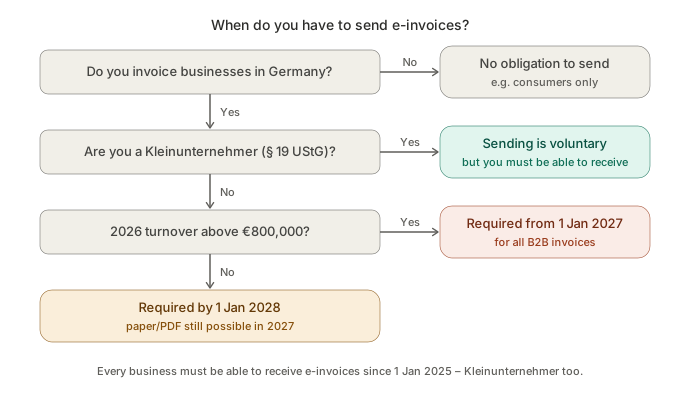
Whether and when you must send e-invoices comes down to three questions: Do you invoice businesses in Germany? Are you a small business under § 19 UStG (Kleinunternehmer)? Was your total 2026 turnover above €800,000? If you invoice businesses, aren't a Kleinunternehmer and are above the threshold, you must issue e-invoices from 1 January 2027; all other B2B invoicers from 1 January 2028 at the latest. Every business has had to be able to receive them since 1 January 2025.
Question 1: Do you invoice businesses in Germany?
The obligation only applies to invoices between businesses that are both established in Germany. Invoices to consumers (B2C) aren't affected, and neither are invoices to clients abroad. A coach with only private clients or a photographer who only shoots weddings doesn't need to change anything — at least not for sending.
Question 2: Are you a Kleinunternehmer?
Invoices from small businesses under § 19 UStG don't have to be sent as e-invoices. You may still send them if your client asks. Details: Small Businesses (Kleinunternehmer) and E-Invoicing
Question 3: Was your 2026 turnover above €800,000?
What counts is your total turnover in the previous year. Above €800,000, you must send e-invoices from 2027. Below it, you may still send paper invoices in 2027 — or PDF invoices if your client agrees. From 2028 the obligation applies to you too.
The exceptions that always apply
- Small-amount invoices up to €250 (gross)
- Travel tickets
- certain VAT-exempt services (§ 4 Nos. 8 to 29 UStG, e.g. many medical or educational services)
For these invoices you may keep using paper or PDF.
Real-world example
A web developer with €90,000 annual turnover, business clients only and standard VAT: question 1 "yes", question 2 "no", question 3 "no". Result: e-invoices required by 2028 at the latest. But because two of his clients want to process only e-invoices from 2027, he's switching in autumn 2026 — legally voluntary, commercially sensible.
What you can do now
Answer the three questions and write down your result. Then add a fourth, practical question: which of your clients will switch earlier than the law requires of you? How to set things up is covered in Your Big Client Wants E-Invoices — Ready in 10 Minutes.
FAQ
Does the €800,000 threshold refer to profit or turnover? Turnover — more precisely, total turnover in the previous year, not profit.
May I send e-invoices before my deadline? Yes. An e-invoice is always allowed; your client doesn't have to agree to it.
What about clients elsewhere in the EU? The German e-invoicing obligation only covers invoices between businesses in Germany. The existing rules still apply to clients abroad.
Note: This article is not tax advice. The binding sources are the German Federal Ministry of Finance and your IHK (chamber of commerce) (both in German); for your specific case, ask your tax advisor.
All of it in 13 pages: Get our free booklet E-Invoicing, Compact as a PDF – with the decision tree, a mistakes check and a switch-over plan – and receive the SmoovOps newsletter. → Get the booklet
Archives
- October 2026 (3)
- September 2026 (4)
- August 2026 (4)
- July 2026 (5)
- June 2026 (4)
- May 2026 (5)
- April 2026 (4)