E-Invoicing in Germany for Freelancers and Small Businesses — The Complete Guide 2025–2028
Posted on August 14, 2026
← Back to Hub: Back-Office Knowledge for Solopreneurs Other cluster guides: Reducing Administrative Work · Managing Customer Data Correctly · Back Office, Not ERP
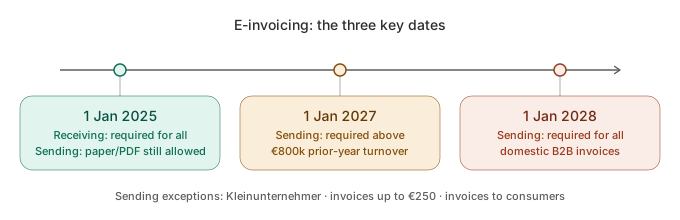
Since 1 January 2025, every business in Germany must be able to receive e-invoices from other businesses — freelancers and small businesses included. For sending, there are transition periods: from 2027, businesses with more than €800,000 prior-year turnover must issue e-invoices; from 2028, everyone who invoices other businesses in Germany. Exceptions include small businesses under § 19 UStG (Kleinunternehmer), invoices up to €250 and invoices to consumers. This guide gives you the building blocks; the linked articles go into detail.
Why e-invoicing is your topic right now
E-invoicing isn't a software trend — it's a legal change that affects every B2B invoice in Germany. For many self-employed people it's the moment they have to look at their invoicing process anyway, and notice how many steps it involves: offer in Word, invoice in one tool, payment in online banking, filing in a folder. If you use the switch to connect that chain, you'll save more time than the switch costs.
If you're new to Germany
If you freelance in Germany as an expat, you've probably met terms like XRechnung, ZUGFeRD and Kleinunternehmer only in German. Most official information is German-only, too. The rules themselves are simpler than the vocabulary: if you invoice German businesses, you need to be able to receive e-invoices now and send them by 2027 or 2028. Everything in this series is written in plain English, with the German terms in brackets so you can recognise them on official pages.
The building blocks at a glance
- Understand what an e-invoice is — and why a PDF by email isn't one. → What Is an E-Invoice — and Why Isn't a PDF One?
- Know which deadline applies to you — in three questions. → What Applies in 2025, 2027, 2028? The Decision Tree for Your Invoices
- Pick the right format — ZUGFeRD or XRechnung. → ZUGFeRD or XRechnung — Which Format Do You Need?
- Be able to receive e-invoices — the obligation that already applies. → Receiving E-Invoices: What You've Had to Handle Since 2025
- Know the rules for small businesses — what you must do and what you don't. → Small Businesses (Kleinunternehmer) and E-Invoicing
- Set up sending before a client asks. → Your Big Client Wants E-Invoices — Ready in 10 Minutes
- Avoid common mistakes that can cost you or your client the input VAT deduction. → The 6 Most Common E-Invoicing Mistakes
- Keep records correctly — eight years, in the original format. → Archiving E-Invoices: What You Must Keep for 8 Years
- Connect the whole flow — from offer to payment. → The E-Invoice Isn't the Whole Job
The three key dates in detail
| From | Receiving | Sending |
|---|---|---|
| 1 Jan 2025 | Required for every business | Paper still allowed, PDF with the client's consent |
| 1 Jan 2027 | Required for every business | E-invoice required if your total 2026 turnover exceeded €800,000 — otherwise paper/PDF still allowed |
| 1 Jan 2028 | Required for every business | E-invoice required for all domestic B2B invoices |
Sending exceptions: small businesses under § 19 UStG, invoices up to €250, travel tickets, certain VAT-exempt services and invoices to consumers (B2C).
Real-world example
A graphic designer with about €60,000 annual turnover assumed e-invoicing wouldn't affect her until 2028. Then her biggest client sent a notice in the autumn: from January 2027, its accounts department would only accept e-invoices so it could process all incoming invoices automatically. Legally she had until 2028 — in practice she had three months. Because she had kept her company profile and client data clean in one place, the switch took one afternoon.
What you can do now
- Use the decision tree to check which deadline applies to you.
- Make sure you can receive and read e-invoices — that already applies.
- Ask your three biggest clients whether they'll expect e-invoices from 2027.
FAQ
Do I have to send e-invoices as a freelancer right now? Not necessarily. Since 2025 you must be able to receive them. Sending becomes mandatory from 2027 (above €800,000 prior-year turnover) or 2028 — if you invoice businesses in Germany and aren't a Kleinunternehmer.
Is a PDF sent by email an e-invoice? No. An e-invoice contains the invoice data in a structured, machine-readable format such as XRechnung or ZUGFeRD. A normal PDF is legally an "other invoice".
Does e-invoicing affect me if I only sell to consumers? The obligation doesn't apply to invoices to consumers. You still need to be able to receive e-invoices as soon as you buy from other businesses.
What happens if I don't send an e-invoice when I'm required to? Your invoice then doesn't meet the formal requirements. Your client risks their input VAT deduction and will ask for a correct e-invoice — which costs time and trust.
All articles in this cluster: What is an e-invoice? · The 2025–2028 decision tree · ZUGFeRD or XRechnung · Receiving e-invoices · Small businesses and e-invoicing · Ready in 10 minutes · The 6 most common mistakes · Archiving e-invoices · Not the whole job
Note: This article is not tax advice. It summarises the rules for invoices between businesses in Germany in plain language. The binding sources are the German Federal Ministry of Finance and your IHK (chamber of commerce) (both in German); for your specific case, ask your tax advisor.
All of it in 13 pages: Get our free booklet E-Invoicing, Compact as a PDF – with the decision tree, a mistakes check and a switch-over plan – and receive the SmoovOps newsletter. → Get the booklet
Archives
- October 2026 (3)
- September 2026 (4)
- August 2026 (4)
- July 2026 (5)
- June 2026 (4)
- May 2026 (5)
- April 2026 (4)